Now I Wanna Sniff Some Glue

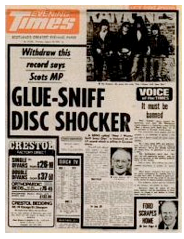
by Jamie Havlin 1976 started with some sickening statistics in Scotland, January proving to be the country’s most murderous ever month on record, with seven killings in Glasgow alone and others in Barrhead, Dundee, Arbroath and Edinburgh. One particularly sickening murder had seen two children found gagged and battered to death in a tenement in Govan. In the months that followed, other alarming statistics and stories emerged; including, after a spate of a dozen or so deaths, the growing menace of solvent abuse. According to the Glasgow Health Board there were a couple of thousand kids in the city sniffing glue. Stories circulated about terrified communities, particularly of old people afraid to go out at night due to the behaviour of feral gangs of kids, high on glue. In rundown, litter strewn, side streets and underpasses, it had become not uncommon to see groups of nauseous looking young boys standing huddled together, some with sores round their lips and glazed eyes, as they blew and sucked glue fumes from emptied crisp bags, ballooning the plastic in and out, in and out. Sniffers could quickly – and cheaply – achieve intoxication, initial euphoria often leading to disorientation before progressing to hallucinatory and delusional experiences of the sort that often gave rise to risk-taking or aggressive behaviour. Fits and unconsciousness were often common while under the influence, as was vomiting, which made asphyxia a possibility. Strathclyde’s Chief Constable David McNee hit out at the increase in the figures and, that summer, the subject reached fever pitch, featuring in the pages of the Scottish press on an almost daily basis, Glasgow’s Evening Times positioning itself at the forefront of an anti-glue campaign along with the Scottish Daily Express and the Sunday Mail, whose front page headline, early in June announced the epidemic was now much worse than teenage alcoholism. In a bid to rehabilitate youngsters suffering from glue addictions, two centres were being set up to make advice and group therapy available, one in the small Ayrshire town of Stevenston, the other in Glasgow, where even kids in the 5-8 bracket, it was claimed, had tried getting high on solvents. Around this time expensive import copies of a self titled debut album began making their way over from America to the more clued-up record stores like Listen in Glasgow and Bruce’s in Edinburgh. The L.P cover presented a curious looking four-piece band. The singer looked like a basketball player who’d given up on eating or cutting his hair. He had a huge gash below the knee of his straight leg jeans, a leather bikers jacket several sizes too small, shades and white – or what might’ve once have been white – sneakers. Together, The Ramones looked like a New York street gang and their songs like Beat on the Brat and Chain Saw stood apart from everything else being sold in Scotland at the time – or anywhere else on the planet for that matter. Anyone hearing the album for the first time would, as the needle was guided onto the crackle of the opening grooves, be instantly struck by the almost impossibly high octane, relentless and pulverizing music; the simplicity of each song, the absence of solos and the choice of subject matter as Joey, in his unique, clipped delivery, sang in the oddest of accents about urban terrorists, rent boys and The Texas Chain Saw Massacre. But it was the shortest track (at fractionally over a minute and half) that proved the most contentious. Penned by bassist Dee Dee, the complete lyrics of Now I Wanna Sniff Some Glue (punctuated with a 1-2-3-4-5-6-7-8 chant) ran: Now I wanna sniff some glue, Now I wanna have something to do, All the kids wanna sniff some glue, All the kids want something to do. The buzzsaw musical accompaniment being almost equally simplistic, though, for a few moments of variation, a guitar and bass riff served as a short instrumental break from Joey’s vocals. Relatively few young Scots who weren’t avid readers of the music press at this point could claim to have even heard of The Ramones, though small pockets of enthusiasts did certainly exist north of the border. Future Next Big Thing fanzine editor Lindsay Hutton, for example, had already purchased the album on a previous visit to the capital and was so enthralled by it that he made the long journey south from Grangemouth to attend their British live debut show on an unbearably hot and sweaty night on American Independence Day, 1976, the band sandwiched between The Stranglers and bill toppers, Flamin’ Groovies at London’s Roundhouse. In Everett True in Hey Ho Let’s Go, he recounted why the night was especially memorable to him and his pal, ‘We met them at the side of the stage: they were thrilled that people from Scotland had come to see them, and gave us wee baseball bats’ (a Sire/Ramones promotional gimmick). The concert, in front of by far the biggest crowd they’d yet performed to, was hailed back home as a major success in magazines like Rock Scene, who celebrated the show with a three page RAMONES BLITZ LONDON spread. Here critics were more divided, some even dumbfounded; Max Bell found them hilarious, ‘I reckon they’re closer to a comedy routine than a rock group,’ he wrote in his New Musical Express review. Many agreed, including future Smith ‘Steve Morrissey’, who co-incidentally, would shortly become a contributor to Hutton’s fanzine. He fired off a letter to the music press, castigating The Ramones and stating that his beloved New York Dolls and Patti Smith were ‘the only acts which originated from the N.Y. club scene worthy of any praise,’ although did he later completely reverse this opinion. After a headlining show the following night at Dingwalls, the group returned to NYC and their first British single Blitzkrieg Bop was released by Sire. They played a series of gigs on America’s East Coast, took a short break, and then embarked on a 13 date