Ecstatic Peace Library publishers have kindly turned all the pages of my Ripped & Torn fanzines, plus Ripping Christmas, into a book which is great news all round.
See their website for more details plus some reviews and images from inside the book.
Here is the cover. This is created from some of my many ways of writing Ripped & Torn on the cover of each issue. Until this book release I didn’t realise I never used the same design twice.
Ripped & Torn Facebook page
I’ve been updating the Ripped & Torn Facebook page regarding this publication, see here for images of press launches from London to Glasgow via Nottingham and Bristol, and appearances on radio shows and media reviews.
Floods of memories
Seeing Ripped & Torn in print form again as a book has been incredible; it brings back a flood of memories, some good some bad.
The book also reveals to me the amount of effort I put into creating each issue, which is impressive now but at the time I just did it.
Growing up in public
Going from issue to issue, as is possible in the book, my own development as a person is evident. It also reveals the changing moods of the times and punk evolved and grew.
I was growing up in public by broadcasting my raw and new found views in each issue, but so was punk as we progressed from Sex Pistols to Ants to Crass. The Sex Pistols I put on a lot of the covers of Ripped & Torn, and I did the first interviews with Adam Ant and Crass.
Now get a copy
Thanks to everyone involved from October 1976 to the present day.
01. “Wake Up (And Make Love To Me)”
02. “Sink My Boats”
03 “Delusions of Grandeur”
04. “Dance of the Crackpots”
05. “What a Waste”
06. “Hey! Hey! Take Me Away”
07. “Hit Me (With Your Rhythm Stick)”
08. “Sweet Gene Vincent’
Out Demons Out by Edgar Broughton Band- included in Dirty Water Volume Two.
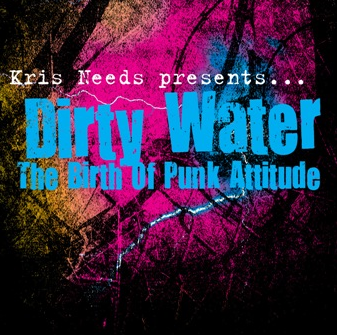
Dirty Water- The Birth of Punk Attitude 1 & 2 – selected by Kris Needs. Available from Year Zero /Future Noise Music. Volume One. Volume Two.
Note: I started writing this review ages ago, but found it a bit of a challenge to my ideas about what punk was/is. I thought I knew my history of punk – until I discovered Dirty Water.
First up – major thank you to Mick Baxter for sending me these. Second up, thanks to Kris Needs for assembling such a boundary/ mind expanding collection of tunes. There are 72 tracks altogether, ranging from Woody Guthrie to Sun Ra, from Gene Vincent to Tapper Zukie…and about a thousand points in between. Or maybe even an infinite number, like a mathematical paradox in which no matter how many extra tracks are added, the Yero Zero of punk can never quite be reached.
Listening through the whole 72 tracks as I have just done, one minute you are swooping down on a wave of sound which is punk as fuck and the next you are whooshing off into some other musical universe. But then as Kris defines/ describes it ‘Punk was an attitude born of either struggle or limited means, which could exist in anything from rooftop doo wop crooners, circuit abusing alchemists or bands picking up guitars and recording themselves with little idea of tradition in their chosen musical genre.’
One way of listening to this sonic assemblage is to hear it as a range of possible/ potential ‘punk’ styles, any one set of which could have become actualised as punk in Year Zero. From the perspective of Year Thirty Six, we know what punk really sounds like so certain tracks jump out as being ancestral to punk. But right up until Year Zero itself this would have been impossible. Only after Vivienne Westwood and Malcolm Mclaren had commodified/fetishised the punk attitude was it possible to do so. Once punk became a product, a saleable commodity, then distinctions between what was and was not punk could be made.
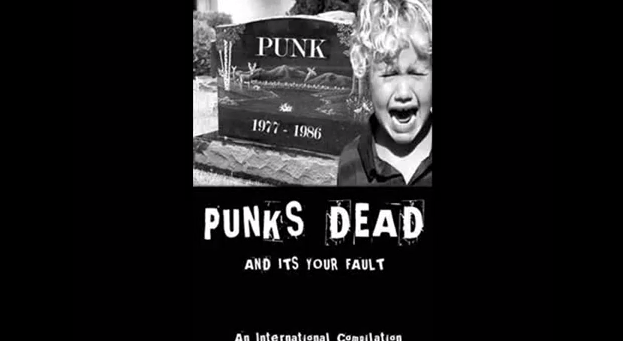
In February 1977, the front cover of International Times (launched in 1966) announced ’Punk is Dead’. By June 1977, Kris Needs was having conversations with various (well known) punks ‘who all bemoaned, in their individual ways, the predictable cliché mentality sweeping a movement supposed to be injecting freshness and destroying old orders. By that summer, punk was increasingly dominated by an ever-swelling army sporting the requisite leather and studs uniforms behaving how they’d read about the Sex Pistols doing in the tabloids, seemingly destined to go the way of the teddy boys….’
One way of visualising this is to imagine an upside down funnel. The broad end of the funnel represents the various potential forms of punk as illustrated by the ‘Dirty Water’ tracks, the narrow end the actuality of punk in 1977. Then imagine a right-way up funnel to represent the post-77 explosion of diversity as creative experimentation began pushing against the boundaries of actualised punk. Mark Perry’s movement through punk as potential, punk as actuality and then on to the possibilities of post-punk illustrate this movement through the phase-spaces of punk.
And then? It all falls apart and what seemed so solid melts into air. In his book ‘England’s Dreamimg’, Jon Savage exhaustively documented the origins of punk as Year Zero. It is a weighty, compelling and compulsive text which seems to explain everything and has the creative tensions of the relationship between Vivienne Westwood and Malcolm Mclaren at its heart. By giving birth to the Sex Pistols, Westwood and Mclaren gave birth to punk through ‘Sex’ (their shop) and stamped their DNA all over it. It is a still powerful myth- but is it history?
The more I listen to ‘Dirty Waters’, the more it begins to wash away the encrusted mythology of punk to reveal the outlines of a more confusing and complex history of punk. This is simultaneously disconcerting and exhilarating. Jon Savage and many others who have written about the origins of punk in the UK focus on the economic crises of the mid-seventies – the shocks caused by the oil price rise which followed the 1973 Arab-Israel war and the conflict between Ted Heath’s Tory government and trades unions/ miners – which led to the 3 day week and power cuts over the winter of 1973/4. Which was then followed by two general elections in 1974 and a minority Labour government which experienced a financial crisis in 1975 when the UK had to be bailed out by the International Monetary Fund.
This creates the impression that punk was in some way a response to these immediate crises- which get mixed up in hindsight with the 1978/9 ‘winter of discontent’ when dead bodies piled up in mounds in the streets. [Allegedly]. This ‘broken Britain’ narrative leads on to the election of Margaret Thatcher in May 1979 and a political/ economic/ social lurch to the right which has lasted down to the present. Punk then becomes a signifier for major social change.
But if the origins of the punk attitude extend further back in time than 1974/5 this narrative loses some of its immediacy. As revised by Kris Needs, punk becomes less unique and its boundaries become blurred. What starts to emerge is punk as part of a long tradition of popular resistance/ opposition to the dominant/ruling structures of society. The music has its origins in the anti-establishment ballads of folk song and the fanzines in the similar broadsheets of the seventeenth and eighteenth centuries. Dig beneath the surface of any historical era and you will find evidence of radical countercultures and of upsurges in political activity which lead to riots and occasionally even civil wars and revolutions.
In the particular case of punk, the deeper historical dimension can be traced back to Malcolm Mclaren and Jamie Reid’s 1970 attempt to document the history of Oxford Street via an unfinished film. ‘The film ends with a grand parade of London stores. In the middle of this spectacle is a scene straight from Situationist demonology: Smoke seen coming from a building, a restaurant is on fire. Procession stops’. The Gordon Riots of June 1780 are also included. Mclaren and Reid’s account begins ‘ The middle class started it against the Catholics. Then hundreds of shop keepers, carpenters, servants, soldiers and sailors rushed into the streets. There were only a few Catholic houses to smash. So they started to smash all the rich houses. The middle classes did nor want anything to do with this. The rioters then burned down all five London prisons. They wanted to knock down everything that stopped them having fun and made them unhappy. They wanted to set all the mad people free and free the lions from the Tower of London’. [ From Jon Savage, England’s Dreaming, 1991, page 41]
The Gordon Riots were just that. No revolution followed them. But nine years later on the 14 July 1789 in Paris a similar explosion of unrest led to the storming of the Bastille prison and the French Revolution. 1793 became Year One of the new French revolutionary calendar and thus the historical origin of punk’s ‘Year Zero’. If the events of May 1968 in Paris/ France had (as the Situationists hoped) led to a new revolution, this would have been another Year Zero. The mythology and rhetoric of the Situationists, if not their critical analysis of modern capitalism, was recycled into punk as a vaguely anarchic sensibility. As punk music mutated into post-punk in 1979/80, the anarchic aspects of punk attitude gave rise to anarcho-punk a few years later. The evolution can be traced through the pages of Ripped and Torn and its successor, Kill Your Pet Puppy.
The last issue of KYPP, No. 6, was published in 1983 and described a (fictionalised) journey to Stonehenge Free Festival. Musically and culturally, this journey marked the re-convergence of punk with the pre/post punk counterculture, with the broader narrative of punk as an attitude which Kris Needs has so effectively presented in the two volumes of ‘Dirty Water’.
“You are sitting in your small room but your mind is like a ballroom” – Alternative TV
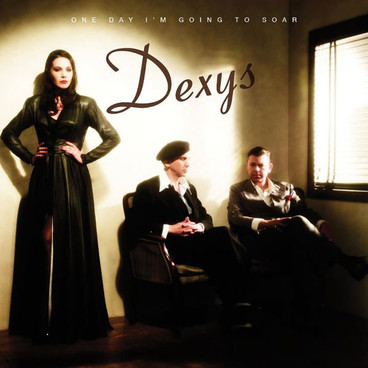
Yes, Kevin Rowland has done it again, 27 years after the last time. It would be silly after a gap like that to say its been worth the wait, but this record does indeed soar and anyone who had a heart will surely soar with it. Listening to “One Day….” on headphones on a mundane crowded train, you can close your eyes and you’re in business class on the way to the Caribbean – flying high just like Kevin’s dreams. It has that power, that magic. It breaks through, it communicates and it oozes naked soul.
Music is your special friend, as Jim Morrison once pointed out so poignantly , but he might have pointed out that, like in real life, that only applies to really special music. So it’s a pleasure to say that Dexys’ 4th album, like it’s 3 predecessors, is one of those albums.
Musically we’re weaving between easy listening, smooth soul and the signature horn and string trademarks that chip in reassuringly from the previous albums. Perhaps the new kid on the block is the introduction of female lead vocals courtesy of Madeleine Hyland, which lend an ambient trance on ‘She’s got a wiggle’ and a sharper theatrical foil on ‘Incapable Of Love’ (the catchiest song won the album, hich curiously seems to prove the opposite of its claims) and elsewhere. ‘I’m Thinking Of You’ has an almost Disney-esque ambience for Rowland to inject his soul over.
‘Nowhere Is Home’ is the one song where Rowland veers away from the Love theme visited from various (often angsty) angles throughout the album. It features Kevin revisiting questions of identity and belonging, a feeling that will be shared by many who’s roots are beyond the simplicity of yesteryear. Untangling his feelings to conclude that freedom lies beyond cheap identity: ‘national identity won’t fulfil me’.
You won’t all agree on the greatness herein though – if Facebook comments are anything to go by, Dexys still have the ability to polarise opinion and indeed inspire contempt. Which in turn makes the faithful love them even more.
Criticisms? Well the album occasionally veers uncomfortably near Style Council territory, which is unsurprising given Mick Talbot’s appearance on keyboards but momentarily drops the sound down a division. The songs are on much surer footing when they employ the familiar, such as the Van Morrison-esque spoken word epic ‘It’s OK John Joe’ that finishes the album.
Whilst Kevin still comes over as the emotional malcontent of yore, there seems an older and sometimes wider head at the controls here, albeit steering the same pounding heart. There’s a subtle humour at play here as well, despite the heavy theme that permeates the album – that of Rowlands journey through various aspects of relationships and his various inner triumphs, failings and existential wranglings therein. This is a story of light and dark, not a struggle for divine symmetry – combined with the continuing natty threads, it’s the polar opposite of Hawkwind and all the more refreshing for it.
Previous Dexys albums have either been celebrated immediately or gone on to be lauded in later years, after initially lukewarm receptions. ‘One Day I’m Going To Soar’ too will be remembered as genius, either now or later. It deserves to be now – these are true redemption songs from someone who knows what soul means. You’ll either love it or hate it but it doesn’t really leave any room for much in between. Knowledge of beauty, in itself, rare, as the man himself once noted.
Yes, a mundane train journey turns into a magic carpet ride. And now an air hostess has just sat down opposite me. How fitting.
Late 70’s punk documentary including tracks by the Sex Pistols, Generation X and Billy Idol.
This fascinating film, shot in 1977-78, documents the early days of the Punk Rock phenomenon. From its beginnings on London’s pub rock circuit to UK chart domination, Punk The Early Years has it all!
Includes performances from Sex Pistols, X Ray Spex, Generation X, The Slits, Siouxsie Sioux, Marc Bolan,The Adverts, Eddie and the Hot Rods, Billy Idol, Poly Styrene and many more! Also includes extensive interviews, including the last-ever with Marc Bolan.
The great Chilean-born director, artist, writer, shaman and “criminal madman, ” Alejandro Jodorowsky interviewed via Skype from a hotel room in NYC on October 30th 2011.
Topics include Occupy Wall Street, why revolutions fail but mutation succeeds, the magical side of reality, the search for gurus and wisdom and why Twitter is the haiku of this century! Jodorowsky’s films El Topo and The Holy Mountain are available on Blu-ray from ABKCO.
The backstory of John Lydon hardly needs telling to anybody reading this website – his adventures with the Sex Pistols are a big part of why Ripped & Torn existed in the first place.
His subsequent choice to explore different experimental pastures with Public Image Limited was, in hindsight, a fantastic example of artistic integrity. The first two albums are classics of the era. Since then PiL’s output has been a rollercoaster of both poignant brilliance and occasional disappointment, if only the disappointment of expecting too much.
The inconsistency of PiL’s output over the years is, to my mind, a sign of an honesty all too rare in bands. It brings with it the (often) welcome breath of unpredictability. They’ve also been knocking crowds dead on the recent spate of gigs, so all the signs are positive. So, what do we get here with the new PiL album? Is the spirit intact?
The album kicks off with ‘This is PiL’ – imagine a football hooligan gatecrashing a Can session. ‘One Drop’ reveals a vague patriotic ex-pat obsession with London. ‘Deeper Water’ even hints at Ennio Morricone guitars along with the trademark Lydon wail. ‘I Must Be Dreaming’ is almost shocking in it’s 80s poppiness, or (as usual) at least it would be without JL mutating the recipe.
‘Human’ is a challenging moment, heavy on the guitars and heavy on the heart “you’re trapped in a class system / that’s pushed you aside / all to the left, all to the right / you’re doomed to slip / you’re doomed to slide / because I think, England’s died” – as I quote those lines, the Queen’s Diamond Jubilee concert is on telly muted in the background and the contrast is delicious – despite Lydon’s sentiments about English roses and cotton dresses, the also-present imagery of school as torture and playing on bombsites remind you that whatever PiL is, it still ain’t showbiz! And ‘Human’ is the highlight of the album to these ears.
Elsewhere, ‘Lollipop Opera’ stands out as one of the livelier tracks, with what sounds like a didgeridoo doodling over a Flowers Of Romance style beat whilst a sometimes megaphoned vocal raps away rhythmically. ‘Reggie Song’ references the Garden Of Eden (but not reggae) and London (again) and rattles along between PiL and PoP – I bet it’s great live. End track ‘Out Of The Woods’ weighs in as the longest (nearly 10 mins) and starts life as a catchy weirdo marching song, like a gentler version of Rocket From The Crypt’s ‘On A Rope’.
The PiL sound over the years hasn’t matured so much as got comfortable in it’s own boots – that’s not a bad thing though, just an observation that as the punk generation has now reached middle-age, ‘This is PiL’ has retained the lyrical dexterity to catch the ear, the astuteness to engage the mind and the wide musical landscapes to sound contemporary and hold your interest. It could never deliver the early avant-garde new thrill of, say, Metal Box but sensibly it doesn’t try.
At the time of writing, of course, we have – as a separate project – Wobble & Levene revisiting those classic Metal Box tracks, and we have Lydon touring with this modern PiL. Purists are welcome to debate which is the more ‘real’ and has the greater claims to authenticity – I’d rather just be greedy and enjoy both.
‘This is PiL…..’ is one of the albums of the year and the best PiL album for many a year. It’s also a damn site more in tune with the punk rock spirit than all the three-chord thrashers out there.
George Berger
Punk legend John Lydon, now leading the latest incarnation of Public Image Ltd will be taking over eMusic to celebrate the release the album “This is PiL”. To read John Lydon’s exclusive interviews and see his view of eMusic, visit www.eMusic.com