


The Cult Studs series continues with musical sociologist Andrew Stevens analysing a compilation album to help understand how punk found suburban youth in 1977 and vice versa a generation later.

“Like the outskirts of Croydon”: The Real Buddhas of Suburbia
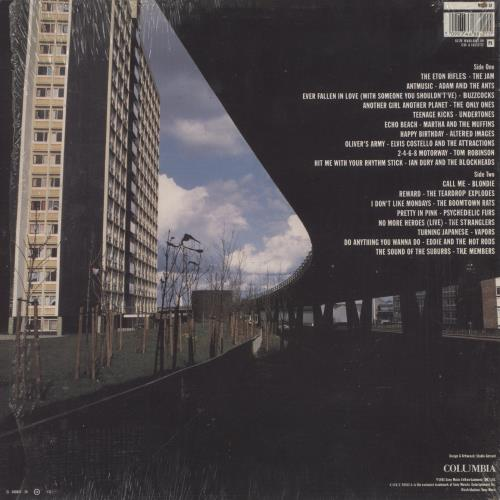
The Sound of the Suburbs was a radio-friendly punk compilation album released in the UK by Columbia Records in 1991. For someone born the year the Sex Pistols formed, I can perhaps be forgiven for giving this album more attention than those who experienced these records first time round. This isn’t the L.A. punk royalty of Penelope Spheeris’ 1983 film of a similar name, nor Hanif Kureishi’s fictionalised treatment of the Bromley Contingent a decade later.
For most of my Smash Hits childhood in the provinces, punk proper remained half-buried beneath new wave and, later, goth. I only ever caught glimpses of it inside seaside gift shops, frayed posters and rusting badges among the Northern Soul patches and 2 Tone wraparound sunglasses, or perhaps in the strange afterlife of Captain Sensible, better known by then for a chart-topping novelty cover of a song from South Pacific. Then, around the age of sixteen, it just suddenly resurfaced. The Clash were soundtracking Levi’s adverts. Channel 4’s Banned season unearthed films and documentaries from the era. These things spoke to and made sense in pre-grunge indie dance-era Britain.
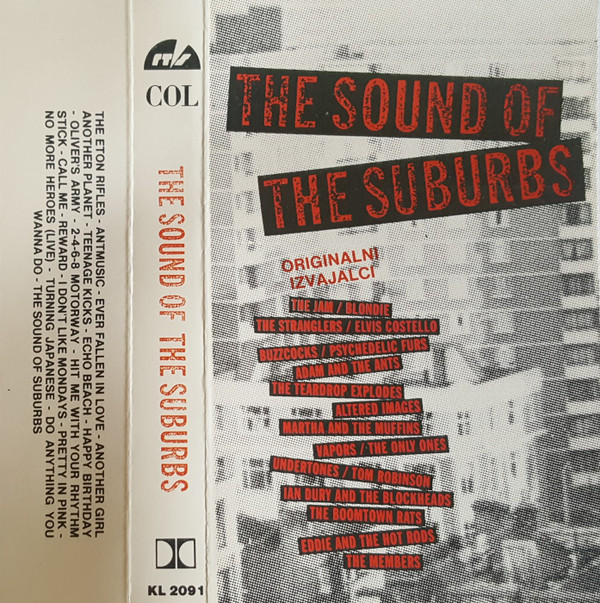
With no older family members around to teach me anything about punk, and long before YouTube or Spotify made musical archaeology effortless, The Sound of the Suburbs became my personal route into discovery. Its sleeve notes essay was written by Jon Savage, not yet quite the leading authority on punk he would become, and contain an argument that quietly upends one of the genre’s founding myths. Punk came to be remembered as “the sound of the city”, but Savage suggests its real audience, and much of its enduring influence, lay elsewhere.
Suburbs occupy an awkward middle ground, close enough to absorb the city’s energy but distant enough to reflect on it.
The question running through his essay is a simple one: was punk fundamentally the sound of the city, or was it the sound that the suburbs absorbed, reshaped, and ultimately amplified? Savage pushes back against the idea that punk was principally an inner London phenomenon. Suburbia, he argues, has long been the real engine room of English pop music — not a cultural wasteland but a launchpad. It produced the Beatles from John Lennon’s semi-detached childhood home on Menlove Avenue; the Rolling Stones in Dartford long before punk arrived; and Bowie in curtain-twitching Bromley.
It’s striking how much punk mythology has come to rest on barely a Monopoly board’s worth of central London addresses — the Roxy on Neal Street, the 100 Club on Oxford Street, SEX on the King’s Road. These places loom so large in the standard retelling that punk can begin to look like something that simply happened to London before radiating outwards. The same could be said of Mod or the Swinging Sixties. Yet while the prissy provincial college deans and city councillors who notoriously banned the Sex Pistols’ tour have become part of punk folklore, it was the Greater London Council that prohibited punk acts from performing in its own venues. Its pompous arts committee chairman Bernard Brook-Partridge even appeared in The Great Rock ‘n’ Roll Swindle suggesting that “most of these groups would be vastly improved by sudden death”. Savage’s suburban thesis doesn’t so much deny the importance of the King’s Road or Soho but rather insists they are only part of the story.
Tellingly, The Sound of the Suburbs had a lesser-known companion in the same compilation series, The Sound of the City, with sleeve notes by Stiff Little Fingers’ Jake Burns (who instead let their “At The Edge” do the talking on the album). Where Savage makes the case for places like Woking, Guildford ,and Canvey Island as punk’s real proving ground, the sequel returns to the familiar mythology of London clubs and boutiques south of Oxford Street. Together the two compilations reveal two competing histories of punk — one centred on the city as stage and spectacle, the other on the suburbs that produced much of its audience and many of its musicians.
Boredom is less a void than an animating force
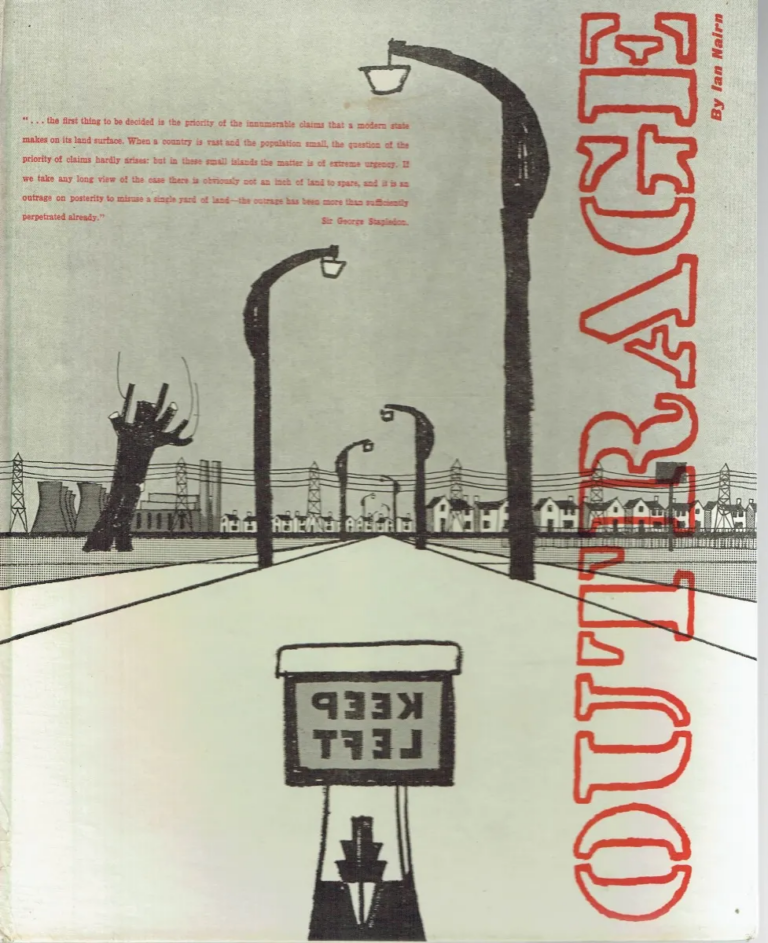
Savage’s psychological argument is perhaps the most interesting. It’s difficult not to think of Ian Nairn here, whose furious 1955 polemic Outrage did more than almost any other work to shape how we understand suburbia. Nairn feared that unchecked suburban expansion would leave England looking “like the outskirts of Croydon”; its actual outskirts gave us, inter alia, the ‘Selsdon Man’ seventies of strife that ushered in punk, the post-mod David Bowie, the cover of the 1971 novel Suedehead, and a host of minor punk acts around Johnny Moped.
Savage reaches almost the opposite conclusion. Suburbs occupy an awkward middle ground, close enough to absorb the city’s energy but distant enough to reflect on it. That distance, he argues, is precisely what made suburbia productive rather than sterile. Where the city overwhelms with stimulation, the suburbs leave teenagers time to sit with an influence, turn it over, and remake it as something of their own. Boredom, in this reading, is less a void than an animating force — the condition under which people begin imagining themselves as musicians, artists, or someone else entirely.
An interesting tension can be found in Savage’s later writing, when he examined his own relationship with Manchester formed by a 1977 visit which presaged a move to the city in 1979 to work at Granada Television at the behest of presenter Tony Wilson, shortly after the latter founded his Situationist project, Factory Records. Writing in Critical Quarterly three decades later, Savage’s essay “The Things That Aren’t There Anymore” looks back at the Northern “Futuropolis” in its decayed austere 1977 version from which the likes of Joy Division and Buzzcocks emerged (he states Unknown Pleasures served as his guide to the city).1 Here he is emphatic that “the relationship of Punk to urbanism was intense and integral” — the dereliction, empty buildings, squats, and abandoned spaces of the post-industrial city provided not merely a backdrop but the physical and psychological (pure psychogeography, as he notes) conditions for a new culture to emerge.
Savage places this argument within a longer critique of urban planning, invoking Jane Jacobs’s The Death and Life of Great American Cities and her warning about the consequences of moving populations out of established urban communities into suburbs and new towns. Read alongside his suburban argument, this suggests that Savage’s real subject may be less suburbia versus the city than the creative possibilities of spaces that sit outside the organised cultural centre. Suburban boredom and urban dereliction are very different conditions, but both create a degree of distance, freedom, and emptiness in which young people can make something of their own.
Punk’s most important legacy was never a fixed sound but a habit of refusing to stand still
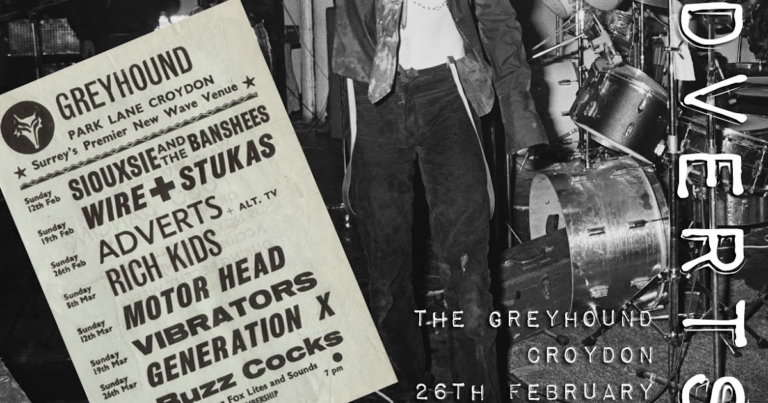
Even before punk’s official flashpoints, bands such as Eddie and the Hot Rods, the Jam, and the Stranglers were already testing a faster, harder sound on the Home Counties pub circuit in places like Canvey Island, Woking, and Guildford throughout 1976. Savage presents these groups as the missing link between pub rock and punk, arguing that it was suburban audiences rather than central London tastemakers who recognised what was emerging first.
The same applies to the fans. The Bromley Contingent, the circle around Siouxsie Sioux and Billy Idol who followed the Sex Pistols from gig to gig, were quintessential suburban day-trippers, catching swing-door trains in from Bromley and Chislehurst before helping define the scene itself. It is also an argument in which Savage has some personal stake. By his own account, his own suburban upbringing sharpened rather than dulled his appetite for pop culture, perhaps explaining why he has always been drawn to telling this side of the story.
By 1977, Savage argues, punk’s initial shock had already begun to fade. What followed were artists who retained its urgency while broadening its musical vocabulary. Tom Robinson Band, Elvis Costello, Ian Dury and the Blockheads, the Boomtown Rats, and Buzzcocks all found larger audiences by demonstrating that punk was less a rigid style than a way of approaching music. By the late 1970s it had already begun dissolving into mainstream pop. The Jam became one of Britain’s dominant singles bands, Blondie fused punk with disco and later hip-hop, while New Pop acts such as the Teardrop Explodes, Altered Images, and the Psychedelic Furs carried the attitude into something brighter, more ambitious and ultimately more international, helping shape the U.S. suburban midwest demi-monde of John Hughes films in the process.
This is also shown in Savage’s view that by 1980 punk was no longer a genre so much as the foundation beneath British pop itself. His essay concludes with Adam and the Ants’ “Antmusic”, a song that rejects tired formulas in favour of constant Year Zero reinvention. Punk’s most important legacy, he suggests, was never a fixed sound to preserve but a habit of refusing to stand still.
Is this the sound produced by the suburbs, or the sound consumed by them?
For the sleeve notes of what was, after all, a budget compilation album, this amounts to a remarkably sophisticated historical argument, even if later scholars such as Matthew Worley have explored the spatial dimensions in punk in greater depth. Savage isn’t simply introducing a collection of songs. He is relocating punk’s centre of gravity away from Chelsea and Camden and towards the ring roads, commuter towns, and pub car parks of Essex, Surrey, and the rest of the Home Counties. That becomes even more interesting when you look at the compilation itself. Is this the sound produced by the suburbs, or the sound consumed by them?
The title track provides an obvious place to start. The Members, who gave the compilation its name, formed in Camberley, the same unglamorous Surrey commuter town surrounded by army bases that Savage’s argument keeps circling back to. “The Sound of the Suburbs” became their breakthrough single, but it followed the non-charting debut single “Solitary Confinement”, which explored the other side of the suburban escape fantasy. One song dreams of leaving home for the city; the other finds its protagonist marooned in an Earl’s Court bedsit, isolated and going nowhere. Taken together they form an almost perfect diptych — first the promise of London, then the loneliness waiting on the other side of the dream.
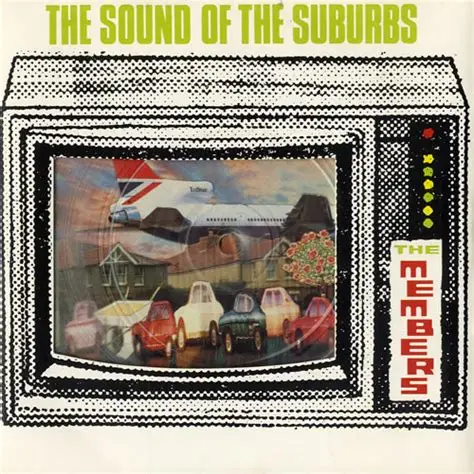
The Members, led by the irrepressible Nicky Tesco and his distinctive lisping delivery, were unmistakably of the suburbs. Much the same could be said of several of the compilation’s other key artists. Paul Weller’s Jam embodied Woking and Stanley Road every bit as much as the London he often held in contempt (a badly received set at the Roxy saw to that), while the Stranglers began life as the Guildford Stranglers. Ian Dury’s “Hit Me With Your Rhythm Stick” may have confidently reworked East End music hall traditions, but his upbringing was resolutely Zone 6 suburban Upminster. Even Blondie’s “Call Me”, born in the East Village and CBGB’s (though adolescent Debbie Harry dreamed her escape from northern New Jersey around the same time that Patti Smith did), became part of the soundtrack of teenage bedrooms, dreary cafés, and Saturdays on provincial high streets far removed from Downtown Manhattan. I grew up often surrounded by farmland, yet Parallel Lines sat permanently in my parents’ wire album rack.
Toronto’s Martha and the Muffins are perhaps the compilation’s least obvious inclusion, but they ultimately reinforce rather than weaken Savage’s case. If “Echo Beach” evokes escape through distance and dislocation, their later single “Suburban Dream” (one of their earliest compositions, penned when the band commuted to college from Etobicoke and Thornhill) turned directly towards the everyday landscapes and quiet anxieties of suburban life itself. It suggests that what Savage identifies was never simply an exclusively British phenomenon but part of a wider late twentieth-century suburban condition, one that stretched as readily to Metro Toronto as it did to Woking. The geography of where songs are recorded, in other words, is only half their story. The places they imagine, and the read across in places in which they are ultimately heard, can matter just as much.
Looking back, it’s telling that my own route into punk didn’t begin with NME retellings of the King’s Road or Soho either, but with a compilation album whose sleeve notes quietly argued that punk’s real story lay elsewhere, where I was. Whether Savage is entirely right is almost beside the point perhaps. Thirty-five years on, amid various celebrations of “Punk at 50”, that argument still feels more radical than much of the mythology it set out to challenge.
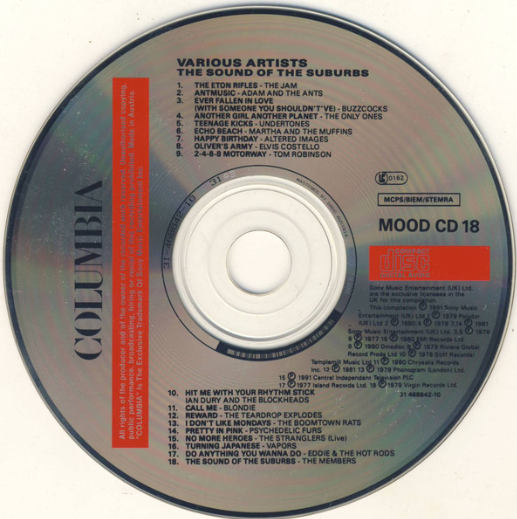
Tracks on the album:
1. The Jam (Woking, Surrey) – The Eton Rifles
2. Adam & The Ants (North London) – Antmusic
3. Buzzcocks (Leigh, Manchester) – Ever Fallen In Love (With Someone You Shouldn’t’ve)
4. The Only Ones (South London) – Another Girl Another Planet
5. The Undertones (Creggan, Derry) – Teenage Kicks
6. Martha & The Muffins (Thornhill, Toronto) – Echo Beach
7. Altered Images (Carmunnock, Glasgow) – Happy Birthday
8. Elvis Costello & The Attractions (North London) – Oliver’s Army
9. Tom Robinson (Cambridge) – 2-4-6-8 Motorway
10. Ian Dury & The Blockheads (Upminster, Essex) – Hit Me With Your Rhythm Stick
11. Blondie (Hawthorne, NJ; Brooklyn) – Call Me
12. The Teardrop Explodes (Tamworth, Staffordshire; Liverpool) – Reward
13. The Boomtown Rats (Dún Laoghaire, Dublin) – I Don’t Like Mondays
14. The Psychedelic Furs (Epsom, Surrey) – Pretty In Pink
15. The Stranglers (Guildford, Surrey) – No More Heroes (Live)
16. The Vapors (Guildford, Surrey) – Turning Japanese
17. Eddie & The Hot Rods (Canvey Island, Essex) – Do Anything You Wanna Do
18. The Members (Camberley, Surrey) – The Sound Of The Suburbs
Notes
1. Savage, Jon. 2008. “The Things That Aren’t There Anymore.” Critical Quarterly 50(1–2): 180–197.
Andrew Stevens’ article was originally published on the Musical Urbanism Substack and is reproduced here with added pictures by agreement.